
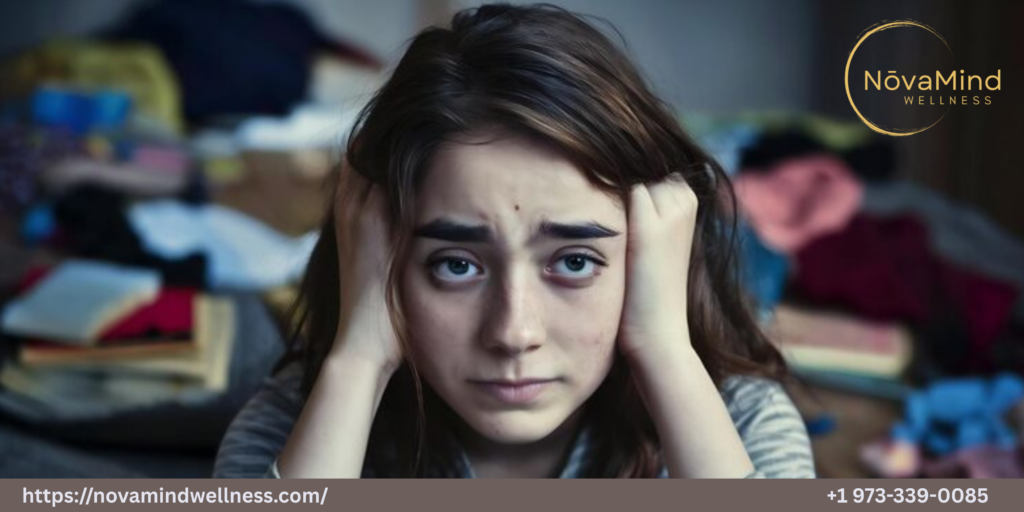
Your teenager goes rigid. Their breathing turns fast and shallow. They grab your arm and say they think they are dying. Nothing visible is wrong, but to them, every physical signal is screaming danger.
That is a teen panic attack. And the way you respond in the next three minutes matters more than most parents realize.
Most parents freeze, panic themselves, or accidentally make it worse by rushing to reassure their teen that nothing is wrong. The problem is, telling someone mid-attack that they are fine does not stop the nervous system from doing what it is doing. It takes a specific, grounded response, and this post walks through exactly what that looks like.
If your teen is struggling with recurring anxiety or panic attacks, the team at NōvaMind Wellness is here to help. Call (973) 828-8075 or contact us online for a confidential consultation, we serve families throughout Morris County, Bergen County, Essex County, and across New Jersey.
Key Takeaways
-
- Teen panic attacks are sudden surges of intense fear with real physical symptoms, they are not behavioral or attention-seeking
-
- The first three minutes of a teen anxiety attack determine how quickly it resolves
-
- Knowing how to help someone having a panic attack is a learnable skill, it does not require medical training
-
- Recurring panic attacks in teenagers are a clinical signal that professional support is needed
-
- NōvaMind Wellness in Morris Plains, NJ provides teen-specific IOP, outpatient, and therapy programs for anxiety and panic disorders
-
- Most major insurance plans cover teen mental health treatment, including IOP and outpatient therapy
Table of Contents
-
- What Is a Teen Panic Attack?
-
- What Causes Panic Attacks in Teenagers?
-
- How to Recognize a Teen Anxiety Attack
-
- The 3-Step Immediate Rescue Plan for Parents
-
- What Not to Do During a Panic Attack
-
- Panic Attacks vs. Anxiety Attacks: Is There a Difference?
-
- When Panic Attacks Signal a Deeper Problem
-
- How NōvaMind Wellness Treats Teen Panic and Anxiety
-
- A Note for Teens Reading This
-
- FAQ
What Is a Teen Panic Attack?
A panic attack is a sudden episode of intense physical fear that peaks within minutes. It is not a mood. It is not an overreaction. The body’s fight-or-flight system fires at full intensity, triggered by perceived threat, even when no real danger is present.
Teen panic attacks are more common than most families know. Research consistently shows that anxiety disorders are the most prevalent mental health condition in adolescents, and panic attacks are one of the most acute ways anxiety expresses itself.
The experience is physical, overwhelming, and, for many teens, genuinely terrifying. Most describe it as believing they are having a heart attack or dying. Understanding that the experience is real, even when the threat is not, is the foundation of responding effectively.
What Causes Panic Attacks in Teenagers?
No single cause explains why a teenager develops panic attacks. Several contributing factors are common:
-
- Chronic stress from academic pressure, social conflict, or family instability overloads the nervous system over time
-
- Trauma or adverse childhood experiences that keep the brain in a heightened state of alertness
-
- Genetics, anxiety disorders run in families; a teen with an anxious parent has a higher biological predisposition
-
- Sleep deprivation, a severely under-rested brain is significantly more prone to anxiety surges
-
- Substance use, caffeine, cannabis, and nicotine (particularly vaping) can all trigger or intensify panic responses in developing brains
-
- Co-occurring conditions including depression, OCD, and ADHD, which often share symptom territory with anxiety
Often, a teen’s first panic attack happens without warning, during a normal school day, at sports practice, or in the middle of the night. That randomness makes the second attack worse, because the teen now fears the panic itself.
How to Recognize a Teen Anxiety Attack
Parents often mistake a teen anxiety attack for a medical emergency the first time they see one. These are the most common physical symptoms:
| Symptom | What Is Happening Physiologically |
| Racing or pounding heart | Adrenaline surge accelerates heart rate |
| Shortness of breath | Breathing becomes fast and shallow, reducing CO2 levels |
| Chest tightness or pain | Muscles tense; reduced CO2 causes chest discomfort |
| Dizziness or lightheadedness | Hyperventilation alters blood oxygen balance |
| Tingling in hands or face | Reduced blood CO2 affects nerve signaling |
| Feeling of unreality | Dissociation as the brain attempts to manage overwhelm |
| Intense fear of dying | The brain interprets physical symptoms as life-threatening |
Symptoms typically peak within 10 minutes and resolve within 20 to 30 minutes. The physical symptoms are real, they are not fabricated or exaggerated. That point matters when you are responding as a parent.

The 3-Step Immediate Rescue Plan for Parents
Step 1: Regulate Yourself First
Your teen’s nervous system is reading yours. If you come in panicked, rushed, or visibly frightened, their system escalates further. Take one slow breath before you speak. Lower your own voice. Move calmly and deliberately.
You do not need to know what to say yet. Your physical presence and your regulated body language are the first intervention.
Step 2: Anchor Them in the Present
Panic pulls the mind into worst-case scenarios and future catastrophe. Your job is to bring them back to the room they are in right now.
Get on their physical level, sit or crouch so you are not standing over them. Make gentle eye contact if they allow it, and say something simple: “I am right here. You are safe. This will pass.”
Then guide their breathing. Breathe visibly slowly yourself and ask them to breathe with you, in for four counts, hold for two, out for six. Do not explain the technique. Just do it alongside them and invite them to follow. This is one of the most evidence-supported ways to help someone having a panic attack because slow, extended exhales activate the parasympathetic nervous system directly.
Step 3: Stay and Stabilize
Do not leave the room. Do not suggest they go lie down alone, check their phone, or distract themselves with TV immediately. Stay present until their breathing has normalized and they can hold a short conversation.
Once they are stable, ask one simple question: “Do you want to talk about it or would you rather just sit for a bit?” Follow their lead. The debrief can wait, what matters immediately is that they feel safe and not alone.
What Not to Do During a Panic Attack
Knowing how to help someone having a panic attack includes knowing what makes things worse. Avoid these responses:
-
- “Calm down” or “just breathe”, this is not actionable information for a brain in crisis and often increases shame
-
- Asking rapid-fire questions, “What happened? Did something scare you? Are you sick?” floods a system that is already overwhelmed
-
- Telling them it is not real, the physical experience is real, even if the threat isn’t; dismissing it damages trust
-
- Expressing your own fear visibly, a parent who says “oh my God, are you okay?!” communicates danger, not safety
-
- Leaving to call someone, staying present is more important than making calls during the episode itself
These responses come from a place of care, but the nervous system does not interpret urgency as reassurance.
Panic Attacks vs. Anxiety Attacks: Is There a Difference?
The terms are often used interchangeably, but there is a clinical distinction worth understanding.
| Feature | Panic Attack | Anxiety Attack |
| Onset | Sudden, often without a clear trigger | Builds gradually in response to a stressor |
| Physical intensity | Severe, heart racing, chest pain, can’t breathe | Significant but generally less acute |
| Duration | Peaks within 10 minutes, resolves within 30 | Can last hours depending on stressor |
| Predictability | Often unexpected | Usually tied to identifiable situations |
| DSM classification | Specific clinical diagnosis | Colloquial term; part of broader anxiety spectrum |
For parents, the practical implication is this: a teen anxiety attack building in response to an exam or social conflict looks different from a sudden, unprovoked panic attack in the car. Both require support, but recurring unprovoked panic attacks indicate a need for professional evaluation.
When Panic Attacks Signal a Deeper Problem
A single panic attack does not necessarily indicate an anxiety disorder. Many teenagers experience one episode and never have another.
Recurring teen panic attacks, particularly those that begin affecting school attendance, social withdrawal, sleep, or avoidance of places where previous attacks occurred, are a clinical signal that the anxiety is becoming structural. Left unaddressed, panic disorder in adolescence frequently worsens, and avoidance behaviors can significantly narrow a teenager’s world.
Families in Morris County, Bergen County, and Essex County reach out to NōvaMind Wellness when they recognize this pattern. Their teen may be refusing school, sleeping poorly, avoiding friends, or struggling in ways that extend well beyond a single episode. That is the threshold where structured treatment makes a measurable difference.
Your Teen Doesn’t Have to Face Anxiety Alone
Panic attacks can leave teens feeling overwhelmed and parents unsure of what to do next. This guide explains how to recognize the signs, respond effectively in the moment, and understand when professional support can help your teen build healthier coping skills and lasting emotional resilience.
How NōvaMind Wellness Treats Teen Panic and Anxiety
NōvaMind Wellness in Morris Plains, NJ specializes exclusively in teen and adolescent mental health. Anxiety and panic disorders are among the most common conditions the clinical team treats, and the approach is individualized from the first session.
Treatment options include:
-
- Intensive Outpatient Program (IOP), structured after-school programming several days per week, allowing teens to stay home and continue school while receiving intensive clinical support. Learn more about the teen IOP program.
-
- Outpatient Therapy, individual and group sessions with flexible scheduling for teens who need ongoing support at a lower intensity. Explore outpatient options here.
-
- Counseling and Psychiatry, individual therapy using CBT, DBT, and ACT combined with psychiatric evaluation and medication management where clinically indicated. See counseling and psychiatry services.
-
- Family Therapy, a structured component of every program, because teen anxiety affects the entire family system and recovery is more durable when parents are actively involved.
Most major insurance plans cover teen mental health treatment at NōvaMind. Verify your insurance here or call (973) 828-8075 for a same-day answer.
A Note for Teens Reading This
If you found this page yourself, that matters. Recognizing that what you’re experiencing has a name, and that it is treatable, is a significant step.
Panic attacks are not a sign that something is permanently wrong with you. They are a sign that your nervous system learned to fire the alarm too hard, and that pattern can change with the right support. Thousands of teenagers work through this in therapy and go on to manage anxiety effectively for the rest of their lives.
You do not have to explain everything perfectly before reaching out. You just have to make one call or send one message.
Medical Review Statement: This article has been reviewed for clinical accuracy by the licensed clinical team at NōvaMind Wellness. It is intended for informational and educational purposes only and does not constitute medical advice or replace professional mental health assessment. If your teen is experiencing frequent panic attacks, significant anxiety, or any mental health crisis, please consult a qualified mental health professional. If your teen is in immediate danger, call 911 or go to the nearest emergency room.
FAQ
What does a teen panic attack look like from a parent’s perspective?
Most parents describe it as sudden and alarming, their teen goes pale, starts breathing rapidly, grabs onto something or someone, and says they cannot breathe or feel like they are dying. It typically resolves within 20 to 30 minutes but can recur. The first time most parents see it, they assume it is a medical emergency.
How do I know if my teen is having a panic attack or a medical emergency?
The symptoms of a panic attack overlap with cardiac and respiratory emergencies. If this is the first episode, if the teen has any history of heart or lung conditions, or if symptoms do not begin to resolve within 30 minutes, seek emergency medical evaluation. Once a panic attack pattern has been established and medically evaluated, future episodes are generally distinguishable. When in doubt, always err toward medical evaluation.
Can panic attacks happen at night during sleep?
Yes. Nocturnal panic attacks are real and relatively common in teenagers. A teen may wake suddenly, heart racing, disoriented, and convinced something is terribly wrong. The experience is particularly frightening because there is no obvious preceding stressor. Nocturnal panic attacks are one of the clearest indicators that professional evaluation is needed.
How do I help someone having a panic attack without making it worse?
Stay calm and stay present. Lower your voice, slow your own breathing visibly, and anchor them with simple language, “I am here, you are safe, this will pass.” Guide breathing together without over-explaining. Avoid questions, reassurances that minimize the experience, or leaving the room. Your regulated presence is the most powerful intervention available.
Are teen panic attacks a sign of a serious mental health condition?
A single panic attack is not a diagnosis. Recurring attacks, particularly those leading to avoidance behaviors, school refusal, or social withdrawal, indicate that the anxiety requires clinical attention. A qualified adolescent mental health clinician can assess whether a panic disorder diagnosis is appropriate and what level of care is needed.
Does NōvaMind Wellness treat teen anxiety and panic disorder in New Jersey?
Yes. NōvaMind Wellness in Morris Plains, NJ specializes exclusively in teen and adolescent mental health, including anxiety disorders and panic disorder. Programs include IOP, outpatient therapy, and individual counseling with psychiatry. The center serves families from Morris County, Bergen County, Essex County, and across New Jersey.
Can therapy actually stop panic attacks from happening?
Therapy does not guarantee that a teen will never experience anxiety again. What evidence-based therapy, particularly CBT, does is change the teen’s relationship with anxiety. They learn to recognize early signals, interrupt the escalation cycle, and respond to fear differently. Over time, panic attacks become less frequent, less intense, and less disruptive to daily life.
Does insurance cover teen panic attack treatment in New Jersey?
Most major insurance plans cover adolescent mental health treatment, including IOP and outpatient therapy, as a covered benefit. NōvaMind Wellness works with most major insurance carriers and can verify your benefits before the first appointment. Start the insurance verification process here or call (973) 828-8075.
At what point should I take my teen to therapy for panic attacks?
If your teen has had more than one panic attack, if attacks are beginning to affect school attendance, sleep, friendships, or daily functioning, or if your teen is expressing fear about having another attack, those are all clear indicators that an evaluation is appropriate. You do not need to wait for a crisis to reach out.
Does NōvaMind Wellness offer after-school programs for teens with anxiety?
Yes. The IOP program at NōvaMind is specifically structured for after-school hours so teens can continue attending school while receiving intensive support. This is one of the most practical aspects of the program for families where disruption to the school schedule is a significant concern.
Help Your Teen Find Solid Ground
Teen panic attacks are frightening for everyone in the room. With the right response in the moment and the right support over time, they do not have to define your teenager’s life.
NōvaMind Wellness in Morris Plains, NJ works exclusively with teens and adolescents. The clinical team understands how anxiety presents in young people specifically, how it differs from adult anxiety, how it intersects with school pressure and social development, and how to build treatment plans that fit a teenager’s actual life.
Call (973) 828-8075 now for a confidential conversation with our admissions team. Contact us online or verify your insurance to find out what your plan covers, most families are surprised by how accessible treatment is. Serving Morris County, Bergen County, Essex County, and families across New Jersey.