
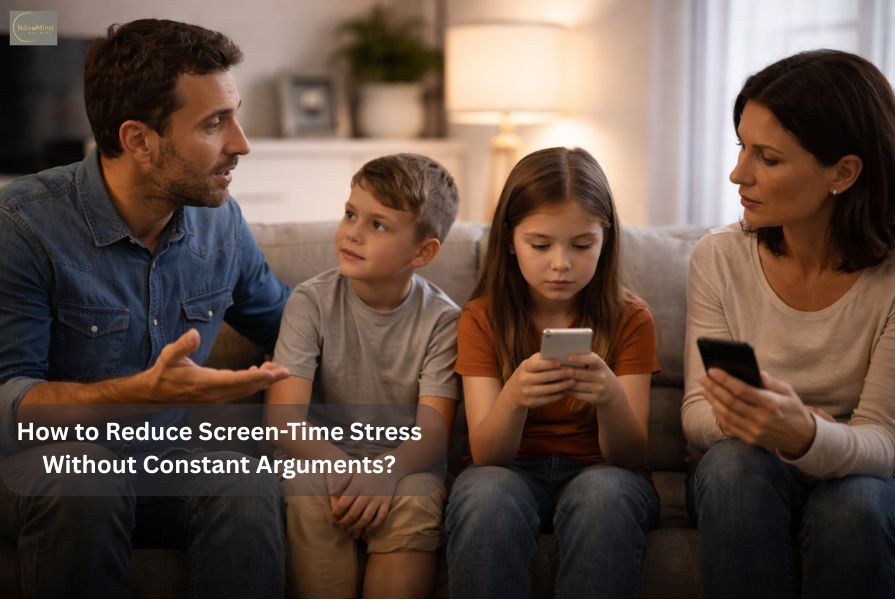
To help a depressed teen with screen time, start with the relationship before the rules. Understand what the screen is doing for them emotionally, involve them in setting limits, protect their sleep first, and seek professional teen mental health support when symptoms persist.
Helping teens with depression starts with understanding what is actually driving their behavior — and for many families, screen time sits right at the center of that tension. Excessive device use can deepen low mood, wreck sleep, and quietly reinforce the isolation that depression thrives on. But taking a phone away without the right conversation almost always makes things worse, not better.
Content Takeaways
- Screen use in depressed teens is usually a symptom of unaddressed pain, not simply a bad habit
- Arguments over devices happen because the teen is protecting a coping mechanism — not because they are being difficult
- Connection before correction is the most effective parenting approach — lead with genuine curiosity about how they are feeling
- Protecting sleep has the strongest evidence base and is the single most defensible boundary to establish first
- Teens follow agreements they helped create far more consistently than rules handed down from above
- When depression is moderate to severe, home strategies need clinical backup — not as a last resort, but as the thing that makes everything else work
- NovaMind Wellness offers after-school IOP, outpatient, and psychiatry programs in New Jersey built specifically for teens and their families.

Why This Feels So Impossible for Parents
You notice your teenager has been in their room for hours. Phone in hand, barely speaking, skipping meals. You try to say something and it turns into a fight. You take the phone and they spiral. You give it back because the alternative feels worse.
This pattern plays out in households across New Jersey every single day. And the reason it keeps repeating is that most conversations about screen time skip the more important question underneath — what is the screen actually doing for them right now?
For a teen without depression, a phone is entertainment and a social connection. For a teen in the middle of a depressive episode, that same phone is often the only thing keeping them from sitting alone with thoughts they do not know how to manage.
That changes everything about how this conversation needs to happen.
What Depression Actually Does to a Teenager’s Brain
Depression in adolescents is not just sadness. It shows up differently than it does in adults, and many parents miss it because they are looking for the wrong signs.
In teens, depression often looks like:
- Irritability and short temper rather than visible crying
- Withdrawal from friends and family, including people they used to love spending time with
- A loss of interest in hobbies, sports, or activities that once genuinely excited them
- Difficulty concentrating at school — grades slipping, assignments not submitted
- Sleeping too much or too little, with no obvious reason
- Physical complaints like headaches or stomach aches with no medical cause
- A general flatness — not sad exactly, just empty
One of the core features of depression is something clinicians call anhedonia — the reduced ability to feel pleasure in things that used to be enjoyable. When everything that requires effort stops feeling worthwhile, low-effort stimulation like scrolling becomes the path of least resistance.
Your teen is not being lazy. Their brain is working against them.
Reduce Screen-Time Stress Without Power Struggles
Managing screen time doesn’t have to lead to arguments. Discover easy strategies to guide better habits while keeping peace at home. Build trust, set clear limits, and support healthier routines without stress or conflict.
Start With a Free ConsultationThe Screen Time and Depression Connection — What Research Actually Shows
There is a real relationship between heavy screen use and teen depression, but it is more nuanced than “phones cause depression.” Understanding the actual picture helps parents respond more effectively.
What the evidence consistently shows:
- Passive use — mindless scrolling, watching other people’s lives, endless comparison — is associated with higher rates of depressive symptoms, particularly in teen girls
- Active use — messaging close friends, creating content, participating in supportive online communities — tends to have a more neutral or even positive effect on mood
- Nighttime device use is one of the clearest contributors to worsened teen mental health because it disrupts sleep, and disrupted sleep worsens depression significantly
- Teens who feel socially disconnected in real life tend to use screens as a substitute for genuine connection — which unfortunately reinforces the disconnection rather than solving it
The American Academy of Pediatrics and the American Psychological Association both recognize the relationship between problematic screen use and adolescent mental health. Their guidance focuses less on total hours and more on what screen time is replacing — sleep, physical activity, and real-world relationships.
Why Arguments Happen — And How to Stop Triggering Them
When a parent takes a device from a depressed teenager, the reaction often seems completely out of proportion. Screaming, door slamming, shutdown, or complete emotional collapse.
From the outside it looks like an overreaction. From the inside of that teenager’s experience, you just removed the one thing making their day bearable.
That does not mean screens are good for them. It means the approach needs to change.
Lead With Curiosity Before You Lead With Rules
The most common mistake parents make is opening with the limit rather than the relationship. “You’re on your phone too much” lands as an accusation. It invites defensiveness, not conversation.
Try something like: “I’ve noticed you seem really drained lately. How are things actually going for you?” That opens a door. It signals that you are interested in them, not just their behavior.
A teenager with depression needs to feel genuinely heard before they can receive any kind of guidance or boundary.
Choose the Right Moment and Setting
Never bring up screen time during an active conflict, or in the immediate aftermath of taking a device away. Choose a calm, low-pressure moment. Car rides are remarkably effective — no eye contact, side by side, something to look at other than each other. Many teens open up in that setting when they would shut down completely face to face.
Focus on What You Observe, Not What You Judge
Instead of: “You’re addicted to your phone and it’s making you depressed.”
Try: “I notice that after a long stretch on your phone at night, you seem harder to reach the next day. I’m wondering if the sleep is getting affected.”
One is a verdict. The other is an observation made from a place of concern. The difference in how it lands is enormous.

Practical Strategies That Actually Reduce Screen Time Without Blowing Things Up
1. Make It a Family-Wide Standard, Not a Teen-Specific Rule
Teenagers notice immediately when rules apply to them but not to adults in the house. If phones away at dinner is the goal, everyone puts their phone away — including you. Shared family norms feel fundamentally different from surveillance.
This also models what healthy limits actually look like, which is something teens with depression often genuinely need to see.
2. Target Sleep First — It Has the Most Evidence Behind It
If you can only win one battle, make it this one. Sleep disruption is one of the most well-documented pathways through which late-night screen use worsens teen depression. A simple charging station outside the bedroom — agreed upon together, not imposed — paired with a consistent expectation that devices stay there after a certain hour, has stronger support in the clinical literature than almost any other single home-based intervention.
Frame this around sleep, not screens. “Your brain needs a proper sleep cycle” is harder to argue against than “you spend too much time on your phone.”
3. Replace First, Then Remove
Every effective behavioral change involves substitution, not just elimination. Before you reduce screen time, ask yourself honestly: what is going in its place?
This does not have to be dramatic. It might be:
- A weekly routine activity that both of you can do together, low pressure, no agenda
- More flexibility to spend time with the one or two friends your teen actually trusts
- Access to a creative outlet — music, art, writing, something physical — that they have shown even mild interest in
- Structured downtime that does not require performance or socializing
The goal is not to fill every hour. It is to give their nervous system something else to land on when the phone is not available.
4. Let Your Teen Help Build the Plan
Research on adolescent development is clear: teens follow agreements they helped create. Rules handed down from above get worked around. Conversations that include genuine input stick longer.
A practical approach: “I want to figure out something around phones at night that we can both actually live with. What do you think is realistic?” You may be surprised what they come back with. And even if their suggestion needs adjustment, you are now negotiating rather than enforcing — which is a completely different dynamic.
5. Know the Difference Between Decompressing and Avoiding
There is a meaningful difference between a teen using their phone for an hour to decompress after a hard school day and a teen who cannot tolerate being offline at all without significant distress.
The first is relatively normal. The second is information — it tells you that the screen is doing heavy emotional work that nothing else in their life is currently doing. And that gap is where professional support becomes important.
When Screen Habits Are a Symptom, Not the Problem
This is the piece that most parenting articles skip entirely, and it matters more than anything else on this list.
For many depressed teens, excessive screen use is not the root cause of their low mood. It is a coping mechanism for pain that has no other outlet. Treating the screen as the primary problem without addressing the depression underneath is like turning off a smoke alarm without looking for the fire.
Signs that screen use may be covering something deeper:
- Your teen has lost genuine interest in activities they used to love, not just traded them for screen time
- Sleep problems or mood changes were present before the heavy screen use started
- There is persistent emotional numbness, hopelessness, or a sense that nothing matters
- They have withdrawn from every real-world relationship, not just in favor of their phone
- You have noticed changes in eating, self-care, or hygiene that go beyond normal teenage behavior
- There are any signs of self-harm or statements that suggest hopelessness about the future
When these signs are present, reducing screen time is still a reasonable goal — but it cannot be the whole strategy. The underlying depression needs clinical attention.

The Role of Professional Support — And How to Bring It Up
Suggesting therapy to a teenager is its own challenge. Many teens associate it with something being “wrong” with them, or worry about being judged by their peers.
A few approaches that tend to land better than others:
Normalize it without minimizing it. “A lot of people find it genuinely useful to have someone to talk to who isn’t family — not because something is broken, but because it’s hard to process everything on your own.”
Give them real input. Let your teen have a say in what kind of support they engage with, what the first appointment will look like, and what they are and are not comfortable discussing initially. A sense of control matters enormously to depressed teenagers.
Frame the first visit as understanding, not treatment. “Let’s just go see what they have to say” is far less threatening than “you are starting therapy.”
Keep showing up even when they push back. Teens with depression often test whether adults will stay consistent when things get hard. Your persistence communicates something important about how much you actually care.
At NovaMind Wellness in Morristown, New Jersey, the teen intensive outpatient program is specifically built to fit around a teenager’s actual life — after school, structured around their schedule, with family involvement built in from the start. It is designed for the teenager who needs more than occasional therapy but does not need to step away from school and daily life to get help.
For teens who need a lighter level of engagement to start, the outpatient program offers continued therapy and goal-setting support at a pace that feels more manageable.
And for families who are not yet sure what level of care is right — or who just need someone clinical to talk to — counseling and psychiatry services offer individual evaluation and personalized guidance.
A Comparison: Reactive vs. Thoughtful Approaches to Screen Time and Teen Depression
| Approach | What It Looks Like | Likely Outcome |
| Reactive — confiscate without conversation | Taking device, no follow-up discussion | Short-term compliance, escalated conflict, no change in underlying mood |
| Rules-only — strict limits without emotional context | Screen locks, timers, content filters | Some improvement in sleep, teen finds workarounds, resentment builds |
| Connection-first — address feelings before limits | Conversation about how they are doing, then collaborative agreement on limits | Slower to implement, significantly more sustainable |
| Clinical support plus home strategy | Therapy, family-based screen plan, consistent parental approach | Best outcomes for moderate to severe depression |
What Families Who Have Been Through This Say
The pattern that comes up again and again when parents reflect on what finally helped is this: things shifted when they stopped treating the screen as the enemy and started treating it as a signal.
The screen was pointing at something. A teenager who did not have the words for what they were feeling. A social life that had quietly collapsed. A level of anxiety or depression that had never been properly named, let alone treated.
The families who made the most progress were the ones who stayed curious, stayed present, and were willing to get outside help before things reached a crisis point.
Frequently Asked Question
What is the right amount of screen time for a teen with depression?
There is no single number. The American Academy of Pediatrics focuses on what screen time displaces — sleep, physical activity, face-to-face relationships, schoolwork. For teens with depression, protecting those things matters more than hitting a specific hour target.
Will taking my teen’s phone make their depression worse?
In the short term, if the phone is their primary coping tool and it is removed suddenly without conversation or alternative support, yes — it can increase distress. A gradual, collaborative approach with alternatives in place is consistently more effective than abrupt confiscation.
When does a teen’s mood and screen use cross the line into needing professional help?
If symptoms have lasted more than two weeks, are interfering with school, friendships, or daily functioning, or if there are any signs of self-harm or hopelessness about the future, a professional evaluation is the right step — not something to wait on.
Is it normal for a depressed teen to prefer screens over everything else?
It is extremely common. Depression reduces the motivation and energy required for activities that involve effort or social risk. Screens provide low-effort stimulation, which is why they become so appealing when everything else feels too heavy to engage with.
How do I set screen limits without it turning into a daily fight?
Involve your teen in creating the agreement. Apply the same standards to yourself. Focus the reasoning on sleep and wellbeing rather than the screen itself. And pick your moments — a calm side-by-side conversation lands completely differently than a confrontation at the end of a difficult day.
What if my teenager refuses any kind of therapy or outside help?
Do not force it and do not give up. Keep short, low-pressure check-ins going. Let them hear that help exists without making every conversation about convincing them. Many teens come around when they feel they have some control over the process. Speaking to a clinician yourself for guidance on next steps is also a reasonable and practical option.
What is an IOP and is it right for a teen with depression?
An Intensive Outpatient Program (IOP) provides structured, multi-day therapy while allowing a teen to stay at home and continue school. It is designed for teens who need more support than standard weekly therapy provides, but who do not need residential care. Nova Mind Wellness offers an after-school IOP in New Jersey specifically built around a teen’s academic schedule.
Does insurance cover teen mental health treatment?
Many major insurance plans cover adolescent mental health treatment, including IOP and outpatient services. NovaMind Wellness works with most major commercial insurance plans and can verify your benefits before your teen’s first appointment.
Your Teen Does Not Have to Stay Stuck
If you have been watching your teenager disappear — into their phone, into their room, into a version of themselves you barely recognize — that is one of the harder experiences a parent can sit with.
The conversation about screen time matters. But the conversation about who your teen is underneath all of it matters more.
NovaMind Wellness in Morristown, New Jersey specializes in teen and adolescent mental health treatment. Their programs are built around real teenagers — the kind who resist help, who need flexible scheduling, and whose families need to be part of the process, not shut out of it.
Call (973) 828-8075 or verify your insurance online to get started today. The call is confidential and there is no pressure.
References & Resources
- American Academy of Pediatrics (AAP) — Screen time recommendations and adolescent mental health guidance
- American Psychological Association (APA) — Research on digital media, social comparison, and teen depression
- National Institute of Mental Health (NIMH) — Clinical information on depression in adolescents
- Substance Abuse and Mental Health Services Administration (SAMHSA) — Adolescent mental health data and treatment resources
- Child Mind Institute — Practical guidance for parents on teen depression, anxiety, and screen use
- Centers for Disease Control and Prevention (CDC) — Youth Risk Behavior Surveillance data on adolescent mental health trends
- 988 Suicide and Crisis Lifeline — Immediate support for teens and families in crisis