
Medically Reviewed by: Akhtar Hossain, Physician – expert in helping people with serious mental illnesses, including but limited to Major depression, bipolar disorder, schizophrenia, anxiety, ADHD, autistic spectrum disorder, substance use disorders.
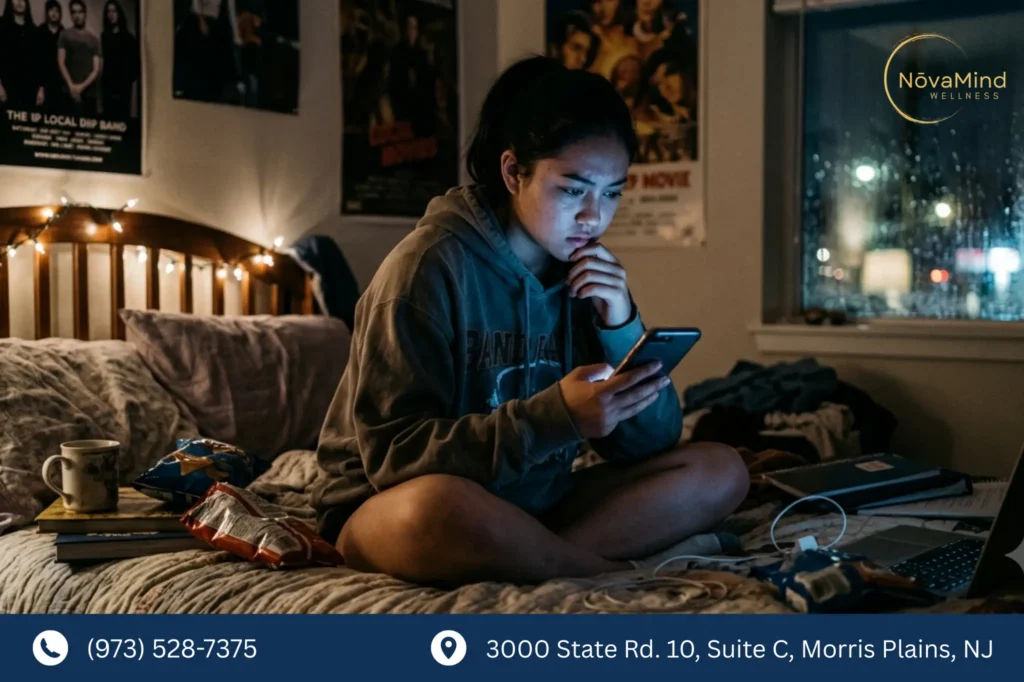
You’ve seen it happen: your teen scrolls for twenty minutes and comes downstairs quieter, more irritable, or visibly upset — and can’t quite explain why. You’re not misreading it. In 2023, the U.S. Surgeon General took the unusual step of issuing a formal advisory on this exact link, and the American Psychological Association followed with its own guidance shortly after. This isn’t a fringe concern anymore — it’s a documented public health issue.
If you’ve searched “is my teen’s phone use normal or a problem” or “can social media cause anxiety and depression in teens,” here’s what the evidence actually says, and what to do with it.
Quick Answer: Is Social Media Hurting My Teen’s Mental Health?
It depends far more on how and how much than on the apps themselves. According to the U.S. Surgeon General’s Advisory, teens who spend more than three hours per day on social media face roughly double the risk of experiencing poor mental health outcomes, including anxiety and depressive symptoms. Passive scrolling and social comparison tend to be the most harmful patterns; active use to maintain real friendships tends to be far less so. The clearest warning sign isn’t screen time alone — it’s whether use is displacing sleep, in-person relationships, and activities your teen used to enjoy.
Real Questions Parents Are Asking
“How many hours of social media is too much for my teen?”
There’s no universal cutoff, but the Surgeon General’s threshold of 3+ hours daily is the most cited benchmark for elevated risk. Pew Research finds 95% of U.S. teens use social media at all, and a growing share — roughly 1 in 5 to 1 in 3 depending on the survey year — describe themselves as online “almost constantly.” That constant-use group is where clinicians see the most concerning patterns.
“Should I just take the phone away?”
Rarely the right first move on its own. Abrupt removal without a plan often triggers intense conflict and doesn’t address the underlying pattern (comparison, validation-seeking, sleep disruption) driving the harm. A structured, gradual approach — ideally with professional guidance if anxiety or depression is already present — tends to work better than an all-or-nothing ban.
“Can social media actually cause depression, or just make it worse?”
Both, depending on the teen. For some adolescents, heavy passive use appears to contribute to the onset of depressive symptoms; for teens with existing anxiety or depression, it frequently intensifies rumination and social comparison. Research in this area is still developing, but the association is consistent enough that the Surgeon General’s advisory specifically flagged it as a risk factor, not just a symptom.
Detection: Specific Signs Social Media Is Affecting Your Teen
Generic “too much screen time” concerns miss the signs that actually matter. Watch for these more specific patterns:
| Signal | What It Looks Like |
|---|---|
| Mood-contingent phone checking | Visibly anxious or deflated within minutes of checking a specific app; mood noticeably improves once off it |
| Sleep displacement | Checking phone within 5 minutes of waking or right before falling asleep; going to bed later than intended “just to finish scrolling” |
| Comparison spiraling | Talking negatively about their own appearance, popularity, or achievements immediately after specific apps (especially image-heavy platforms) |
| Secretive or defensive use | Hiding the screen when a parent walks by; irritability when asked about app use; multiple accounts parents don’t know about |
| Phantom anxiety without the phone | Restlessness, irritability, or checking a pocket repeatedly when the phone isn’t accessible |
| Displaced activities | Hobbies, sports, or in-person friendships that have quietly dropped off in favor of screen time |
Not All Social Media Use Affects Teens the Same Way – Understand the Pattern
| Pattern | Typical Effect |
|---|---|
| Passive scrolling & comparison (viewing curated content without interacting) | Most strongly linked to lower self-esteem, body image concerns, and depressive symptoms |
| Active, relationship-focused use (messaging friends, group chats) | Generally neutral to mildly positive — maintains real-world social bonds |
| Algorithm-driven “rabbit holes” | Can repeatedly surface distressing or extreme content to already-vulnerable teens, reinforcing negative thought patterns |
| Cyberbullying or exclusion exposure | Strongly linked to anxiety, depressive symptoms, and school avoidance |
| Identity-affirming communities | Can be genuinely protective — the Surgeon General’s advisory notes many adolescents, especially in marginalized groups, report finding supportive, identity-affirming content online |
The takeaway clinicians emphasize: it’s the pattern of use, not the existence of an account, that determines the risk.
Healthy Use vs. Problematic Use
| Healthy Pattern | Problematic Pattern |
|---|---|
| Used to coordinate with real-life friends | Primary source of social connection, replacing in-person contact |
| Time limits held even when reminded once | Repeated broken agreements about time limits |
| Mood stays stable after logging off | Noticeable mood shift (down or anxious) after specific apps |
| Sleep schedule protected | Sleep consistently delayed by scrolling |
| Can go a day without it without distress | Visible anxiety or irritability when access is restricted |
The Risk of an Unaddressed Pattern
Left unaddressed, a heavy passive-use pattern tends to follow a recognizable escalation:
| Stage | What Often Happens |
|---|---|
| Weeks 1–4 | Increasing time online, mild comparison-driven mood dips, minor sleep delay |
| Months 1–3 | Sleep debt builds, irritability increases, in-person plans start getting declined in favor of being online |
| Months 3+ | Withdrawal from previously enjoyed activities, worsening self-esteem, and — in a meaningful subset of teens — the emergence of clinical anxiety or depressive symptoms |
Bold and important: this progression is not inevitable, and plenty of teens use social media heavily without lasting harm. But when a parent notices stages one and two already underway, that’s the window where a conversation — or a professional consultation — has the most impact before patterns solidify.
Understand with Real Life Incident
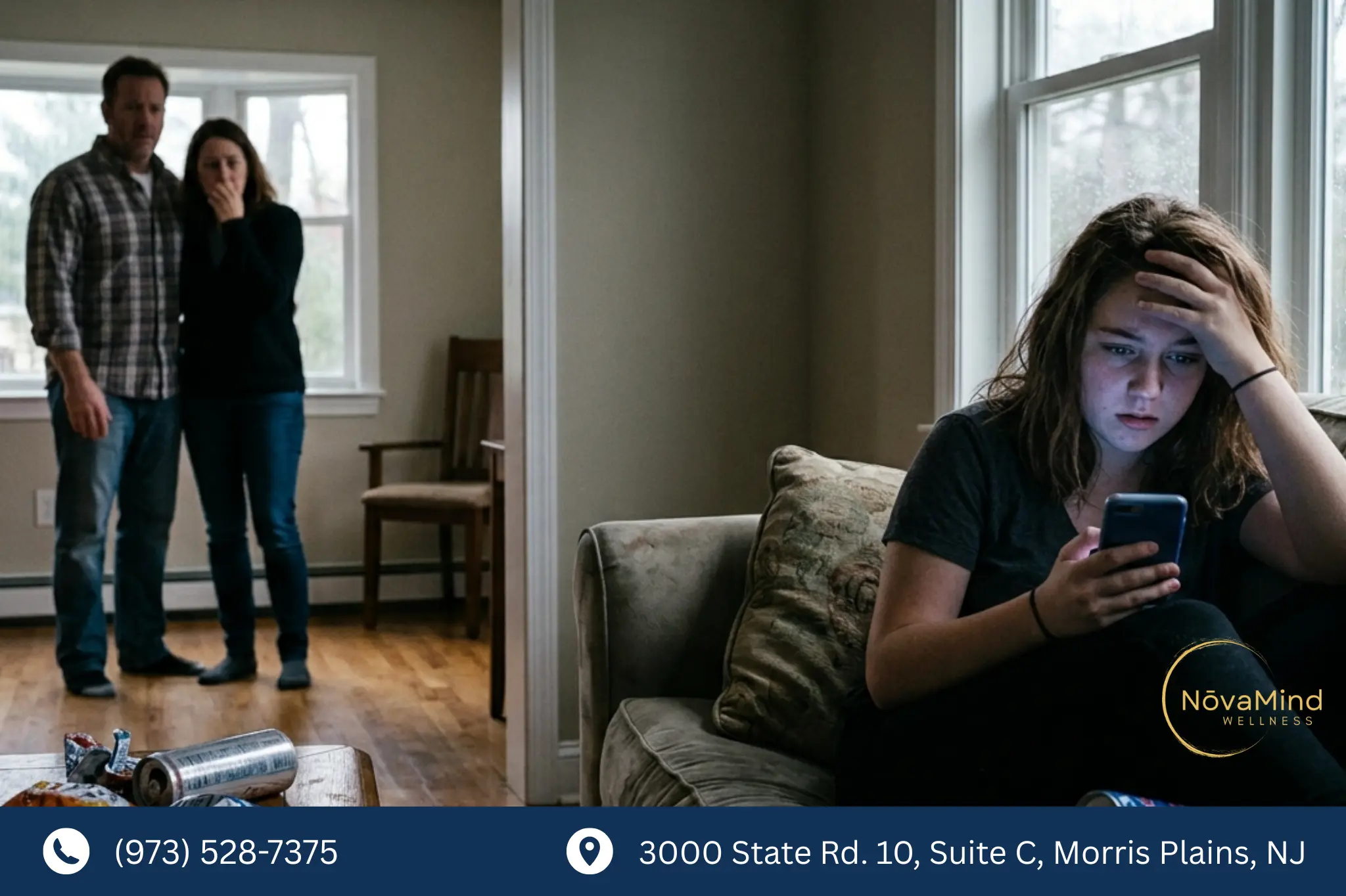
A 14-year-old who had always been sociable began spending several hours nightly on an image-based app, often re-taking and deleting photos before posting. Sleep shifted later, grades dipped slightly, and she became noticeably quieter around mealtimes. Her parents initially attributed it to “just being a teenager.” A brief clinical conversation revealed a pattern of comparison-driven anxiety tied specifically to the app — not a broader mood disorder. A structured plan (device-free evenings, a later notification cutoff, and a few therapy sessions focused on the comparison cycle) resolved the sleep disruption within weeks and noticeably eased her anxiety around posting.
Frequently Asked Questions (FAQs)
Q. Is social media designed to be addictive for teens?
Yes, in large part. Many platforms use engagement-optimized algorithms, infinite scroll, and notification systems specifically built to maximize time spent — features researchers note can be especially hard for the still-developing adolescent brain to self-regulate around.
Q. Does deleting the apps fix teen anxiety caused by social media?
Sometimes, especially when passive scrolling is the main driver. But removing the app without addressing the underlying comparison or validation-seeking pattern often just shifts the behavior elsewhere. Pairing a break with therapy tends to produce more lasting change than removal alone.
Q. What age should teens be allowed on social media?
There’s no single medically endorsed age. The Surgeon General’s advisory recommends delaying access as long as reasonably possible and treating early adolescence as a higher-risk window that needs closer oversight, not a fixed cutoff.
Q. Is heavy social media use a cause of anxiety, or a symptom of it that’s already there?
It can be either. For some teens, heavy use contributes to anxiety developing. For others, escapist scrolling is a coping response to anxiety or depression that’s already present. This is exactly why a clinical evaluation — not just a screen-time rule — is often the more useful next step.
Q. How many hours of social media use is considered unhealthy for a teenager?
There’s no single universal number, but the U.S. Surgeon General’s advisory associates 3+ hours daily with roughly double the risk of poor mental health outcomes. The hour count matters less than whether use is displacing sleep, schoolwork, or in-person relationships.
Q. Are some social media platforms more harmful to teen mental health than others?
Image- and video-heavy platforms built around appearance and curated content tend to be more strongly linked to comparison-driven anxiety and body image concerns than messaging-based platforms used mainly to stay in touch with real-life friends. Format matters as much as the specific app.
Q. Why do I feel worse about myself after scrolling through social media?
This is a very common experience, especially on image-based apps, and it has a name: social comparison. Seeing a constant stream of curated highlights from others’ lives, without the context of what’s left out, is strongly linked to lower self-esteem — particularly among teenage girls.
Q. Is it normal to feel anxious or on edge when I don’t have my phone?
Mild discomfort is common, but persistent anxiety, restlessness, or trouble focusing without your phone nearby can signal that use has become a coping mechanism rather than just a habit — and it’s worth talking to a parent, counselor, or therapist about.
Q. Can a teen therapist help with cyberbullying, not just general anxiety?
Yes. Therapists who specialize in adolescent mental health are trained to address cyberbullying’s specific emotional impact — including anxiety, social withdrawal, and school avoidance — alongside broader coping and safety strategies.
Q. What’s the difference between normal teenage social media use and a problem that needs professional help?
Normal use doesn’t consistently disrupt sleep, mood, grades, or in-person relationships. When those areas are visibly and repeatedly affected — not just occasionally — it’s reasonable to seek a professional evaluation rather than wait for it to resolve on its own.
Q. Where can I find a therapist near me who treats teen social media-related anxiety in Morris County, NJ?
Nova Mind Wellness, based in Morris Plains, NJ, provides evidence-based therapy for adolescents dealing with social media-related anxiety, depression, and related concerns, serving families throughout Morris County, including Morristown, Parsippany, Randolph, Denville, Mountain Lakes, Madison, Chatham, and Florham Park.
Q. Does Nova Mind Wellness treat teens from Parsippany, Randolph, and Denville, NJ?
Yes. Nova Mind Wellness works with adolescents and families throughout the greater Morris County area, including Parsippany, Randolph, and Denville, in addition to Morris Plains and the surrounding communities.
Q. Does insurance cover therapy for social media-related anxiety or depression in New Jersey?
Coverage depends on your specific plan. Nova Mind Wellness can verify your insurance benefits before your first appointment — visit the Verify Insurance page or call our office to confirm what’s covered.
When to Seek Professional Help
Consider a professional evaluation if your teen shows several of the following:
- Visible anxiety, sadness, or irritability tied to specific apps or being online
- Sleep consistently disrupted by phone use
- Withdrawal from in-person friendships or previously enjoyed activities
- Secretive or defensive behavior around device use
- Signs of cyberbullying, exclusion, or harassment
- Any expression of hopelessness, self-harm, or not wanting to be around
Get Support for Your Teen in Morris Plains, NJ
If social media seems to be affecting your teen’s mood, sleep, or self-esteem, a professional evaluation can pinpoint what’s actually driving it — comparison, anxiety, depression, or something else — and build a plan that doesn’t rely on an all-or-nothing phone ban. Nova Mind Wellness supports families throughout Morris Plains, Morristown, Parsippany, Randolph, Denville, Mountain Lakes, Madison, Chatham, and Florham Park, NJ.
Related Resources
- Teen Counseling & Psychiatry Services
- Understanding Teen Anxiety: Symptoms, Causes & When to Seek Help
- Your Teen Is Depressed—Now What?
- Mental Health Conditions We Treat
- Verify Your Insurance
Schedule a Confidential Evaluation
📞 Call (973) 828-8075 📍 3000 State Rd. 10, Suite C, Morris Plains, NJ