
Objective
This blog explains the difference between mental health apps and in-person therapy for teens. It looks at what each option does well, where each one falls short, and how families can decide what kind of support makes the most sense. The goal is to help readers understand when therapy apps are most useful and when face-to-face care is the better choice.
Key Takeaways
- Mental health apps can make support feel easier to reach.
- The best therapy apps may help teens track mood, practice coping skills, and build healthy habits.
- In-person therapy gives teens direct support from a trained professional.
- Apps can be helpful tools, but they are not always enough on their own.
- Some teens do well with a mix of both options.
- The right choice depends on the teen’s needs, comfort level, and the seriousness of the problem.
Table Of Contents
- Why This Topic Matters For Teens
- What Mental Health Apps Usually Offer
- What In-Person Therapy Offers Teens
- Best Therapy Apps Vs In-Person Therapy For Teens
- When Mental Health Apps May Be Helpful
- When In-Person Therapy May Be The Better Choice
- Can Teens Use Both At The Same Time?
- How Parents Can Help Teens Choose Wisely
- What To Look For In Support Tools
- FAQs
1. Why This Topic Matters For Teens
Teen life can feel heavy. School pressure, friendship problems, body changes, social media, family stress, and future worries can all affect mental health. Some teens often feel nervous. Some feel stuck, angry, lonely, or emotionally drained. Because of this, many families start looking for support but are not always sure where to begin.
This is why the conversation around mental health apps and therapy matters so much. Apps are easy to download and often feel less intimidating. Therapy can feel more serious, but it may also offer deeper help. At Nova Mind Wellness, this question matters because many teens and parents want support that feels real, practical, and easy to understand.
2. What Mental Health Apps Usually Offer
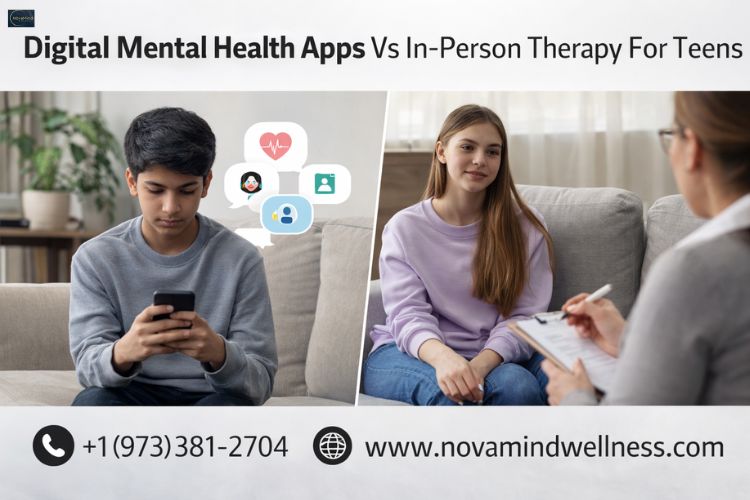
Many mental health apps are built to help users manage emotions, build routines, and learn simple coping tools. Some include mood tracking. Some guide breathing exercises. Some offer journaling prompts, meditations, sleep sounds, or short lessons about stress and feelings.
Common features include:
- Mood check-ins
- Guided breathing
- Journaling tools
- Sleep support
- Habit tracking
- Mindfulness exercises
- Positive reminders
The best therapy apps often make these tools simple and easy to use. That can help teens who feel overwhelmed and do not know where to start. A teen may be more willing to open an app for five minutes than talk to an adult right away.
Still, apps have limits. They cannot truly understand a teen as well as a trained therapist can. They also cannot build the same human connection that happens in a real therapy session.
3. What In-Person Therapy Offers Teens
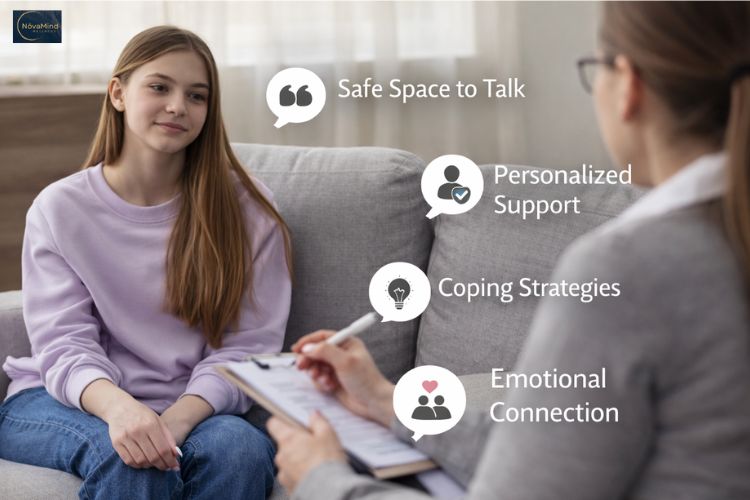
In-person therapy gives teens something apps cannot fully replace. It gives them time with a trained professional who listens, asks questions, notices patterns, and helps them work through problems more deeply.
Therapy may help teens with:
- Anxiety
- Ongoing sadness
- School stress
- Family conflict
- Low self-esteem
- Friendship struggles
- Trauma
- Emotional outbursts
- Trouble coping with change
A therapist can adjust care based on the teen’s age, personality, family life, and emotional needs. That matters because two teens may have the same symptom on the surface but very different reasons behind it.
Unlike mental health apps, therapy also gives teens a private space to speak openly, reflect, and feel heard. That relationship can be a major part of healing.
4. Best Therapy Apps Vs In-Person Therapy For Teens
The question is not always which one is better in every case. The better question is which one is right for the teen’s current needs.
Here is a simple comparison:
| Area | Best Therapy Apps | In-Person Therapy |
| Access | Easy to download and use | Requires booking and travel |
| Cost | Often lower cost | Usually costs more |
| Human Support | Very limited or none | Direct support from therapist |
| Personalization | Basic or automated | Strongly personalized |
| Privacy | Depends on app settings | Private professional setting |
| Depth Of Help | Good for light support | Better for deeper issues |
This is where families need to be realistic. The best therapy apps can be great tools, but tools are not the same as treatment. In the middle of care planning, Nova Mind Wellness would likely focus on what the teen is really dealing with, not just what feels easiest to access.
5. When Mental Health Apps May Be Helpful
There are many situations where mental health apps can be useful for teens. They may help when a teen wants to start building awareness around stress, sleep, mood, or coping habits.
Apps may be helpful for teens who:
- Want simple daily support
- Need reminders to pause and breathe
- Like tracking moods and patterns
- Feel stressed but still function well day to day
- Want help building routines
- Are you waiting to begin therapy
- Already attend therapy and want extra support between sessions
For these teens, the best therapy apps can feel like a small but useful step. They can make emotional care feel less scary and more normal. That matters, especially for teens who are just beginning to open up.
6. When In-Person Therapy May Be The Better Choice
Sometimes an app is not enough. A teen may need face-to-face support when emotions are getting in the way of daily life or when the problems have lasted for a while.
In-person therapy may be the better choice when a teen:
- Feels sad or anxious most days
- Has trouble functioning at school or home
- Stops enjoying normal activities
- Seems withdrawn for a long time
- Has major family or friendship stress
- Struggles with anger, panic, or emotional shutdown
- Needs deeper guidance and steady support
This does not mean mental health apps are useless. It only means they should not carry more weight than they are built to handle. An app may offer coping tips, but it cannot replace careful human understanding.
7. Can Teens Use Both At The Same Time?
In many instances, it is effective. Some teens can get therapy sessions and app-based support throughout the week. Therapists can assist a teenager in understanding deeper emotional issues, and an app could help them learn breathing techniques, relaxation, and sleep patterns, or even help them journal between sessions.
This type of mix could help teens stay involved in their care. It could also make the lessons in therapy easier to remember during everyday life. The most important thing is balancing. The app must complement the process, not replace it.
This is usually the most sensible view. The most effective therapy apps are useful as side tools, but therapy is the primary source of assistance and personal development.
Teens and Mental Health: Apps or Real-Life Therapy?
Teens today can choose between digital mental health apps and real-life therapy for support. While apps offer quick and easy access, in-person therapy provides deeper connection and guidance. Understanding the difference helps teens and parents choose what truly supports long-term emotional well-being.
Start With a Free Consultation8. How Parents Can Help Teens Choose Wisely?
Parents do not have to be experts on everything. It is enough to remain at ease, attentive, and flexible. Teens are more likely to be supportive when they feel valued and not pressured.
Parents can help by:
The teen is asked how he is feeling
Be attentive without jumping to conclusions
The patterns are apparent, but it’s not a bad day.
Explore options with others
Verifying app privacy and quality
Being willing to attend therapy if a teen needs more help
For Nova Mind Wellness, the most beneficial mindset is straightforward: pick the right support based on your needs, not just convenience.
9. What To Look For In Support Tools?
When it comes to choosing mental health or therapy apps, quality counts. A good support experience should be safe and clear. It should also be age-appropriate.
Look for tools that offer:
- Easy language
- Clear privacy rules
- Healthy coping skills
- Realistic advice
- Teen-friendly design
- Support from qualified professionals when needed
The strongest choice is usually the one that helps the teen feel supported, understood, and able to keep moving forward.
Conclusion
Both mental health apps and in-person therapy can play a useful role in teen mental health support. The best therapy apps may help with routines, mood tracking, and coping skills, especially for teens who want a simple starting point. In-person therapy offers something deeper through real connection, careful guidance, and support shaped around the teen’s life. In many cases, the best answer is not one or the other. It is choosing the right level of care for the real problem. Nova Mind Wellness reminds families that mental health support works best when it is thoughtful, steady, and built around the teen, not just the tool.
FAQs
Are Mental Health Apps Good For Teens?
They can be helpful for stress tracking, coping tools, and daily habits. They are often best for light support or as a tool alongside therapy.
Can The Best Therapy Apps Replace A Real Therapist?
Not fully. The best therapy apps may support healthy habits, but they do not replace a trained therapist who can give personal care and deeper guidance.
When Should A Teen Try In-Person Therapy Instead Of Mental Health Apps?
In-person therapy is often better when emotions affect school, family life, sleep, daily functioning, or relationships for more than a short period.
Is It Okay For Teens To Use Both Therapy And Apps Together?
Yes. Many teens do well when they use therapy for deeper support and apps for daily coping practice between sessions.
What Should Parents Check Before Choosing Mental Health Apps?
Parents should check privacy settings, age appropriateness, cost, features, and whether the app provides safe, realistic advice.